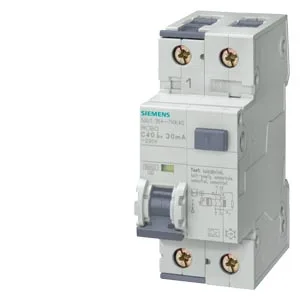
What it is and what it does
The Siemens SENTRON 5SU1354-1KK40 is a 2-pole (1P+N) RCBO — a combined residual-current device and miniature circuit breaker in a single 36 mm-wide unit (2 modular widths). It's rated 40 A at 30 °C ambient, with a C tripping characteristic for moderate inrush loads like motor starters or lighting banks. The Type AC residual-current sensing handles sinusoidal AC fault currents only — not pulsed DC or smooth DC, so keep that in mind for VFD-fed or rectifier-fed circuits. Breaking capacity is 10 kA per EN 60898 and 15 kA per IEC 60947-2 — the higher figure applies when the device is used as a distribution board component per the manufacturer's instructions. That's enough for most commercial and light industrial panels where the prospective fault current stays under 10 kA; the 15 kA rating gives headroom for IEC-specified installations with higher available fault current. Rated voltage is 230/240 V AC at 50 Hz, supply can enter from top or bottom, and the device can be mounted in any position — useful when panel layout is tight. The IP20 rating applies once the distribution board is installed with conductors connected; the unit itself isn't sealed against dust or moisture ingress.
Thermal derating — the real-world rating
The 40 A rating holds at 30 °C. Above that, the continuous current must be reduced: 37.6 A at 40 °C, 36.4 A at 45 °C, 34.8 A at 50 °C, 32.4 A at 55 °C and 60 °C, 30.8 A at 65 °C, and 29.2 A at 70 °C. If the panel ambient runs hot — say, 50 °C inside a crowded enclosure — the effective rating drops to 34.8 A. Size the upstream protection and load accordingly.
Panel fit and installation
The unit occupies 2 modular widths (36 mm) on a DIN rail, with a depth of 77 mm and an installation depth of 70 mm. The 90 mm height fits standard distribution board cutouts. Spring-cage terminals accept the usual copper conductors; no special tooling needed beyond a screwdriver for the terminals.
