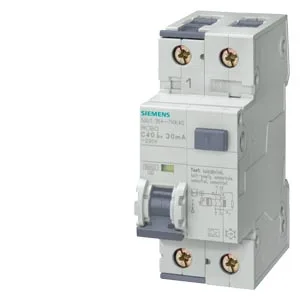
The Siemens 5SU1354-1KV20 is a combined residual current device and miniature circuit breaker (RCBO) — an FI/LS protector — in a single 1+N-pole module. It provides both earth leakage and overcurrent protection in one DIN-rail unit, saving panel space compared to separate RCD and MCB.
Rated at 20 A with a C-trip curve (C 20A), this RCBO is sized for general-purpose inductive and lighting loads where inrush currents are moderate — think small motor circuits, contactor coils, or mixed socket outlets. The C curve means magnetic trip occurs at 5–10× rated current, so it avoids nuisance tripping on transformer or capacitor inrush while still clearing hard faults. The residual current sensitivity is 30 mA (IFN 30MA), the standard threshold for personal protection against electric shock per IEC 60364. At this sensitivity the device will trip within 300 ms at rated residual current, and faster at higher leakage levels. The Type AC waveform detection means it is suitable for circuits with sinusoidal leakage only — not for variable-speed drives, UPS systems, or LED drivers that generate pulsed or high-frequency leakage currents. The 70 mm depth (D=70MM) is the overall body depth from the DIN-rail mounting surface to the front face. That dimension matters when fitting into shallow enclosures or when a transparent door or cover must close over the device. The 1+N-pole configuration switches both phase and neutral, with the neutral pole switching but not protected against overcurrent — standard for single-phase final circuits in TN and TT systems.