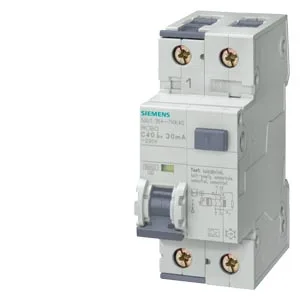
The Siemens 5SU1354-1LV25 is a combined residual-current device and miniature circuit breaker (RCBO) — an FI/LS-protector — in a 1+N-pole form factor. It combines Type AC residual-current detection at 30 mA with a C-curve overcurrent trip at 25 A, all rated for a 10 kA short-circuit breaking capacity. The G-type designation indicates a short time delay (typically 10 ms) to coordinate with downstream devices and reduce nuisance tripping on transient surges.
The 30 mA sensitivity covers the standard personnel-protection threshold per IEC 60364 — it clears earth faults before they reach a dangerous let-through energy level. The 70 mm width (about 4 module spaces on a DIN rail) is standard for a 1+N RCBO in the Siemens 5SU family, so it slots into any 18 mm-module enclosure without crowding.