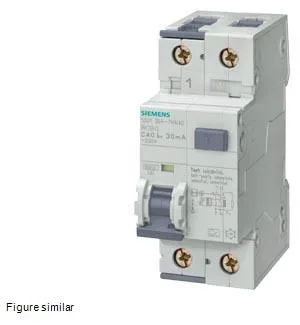
The Siemens 5SU1354-1LV32 is a combined residual-current device and miniature circuit breaker (FI/LS protector) in a single 1+N-pole module. The G-type designation means it's selective (time-delayed) against nuisance tripping from transient surges or inrush currents — useful on circuits feeding motor loads or capacitive supplies where a standard instantaneous RCD would drop out on start-up.
The G-type (time-delayed) selectivity means this unit can be installed downstream of a time-delayed main RCD without losing coordination — the main RCD sees the fault first and clears it, leaving this device untripped.
Deployment context
The 70 mm depth (D=70mm) is the standard module width for a 1+N RCBO, so it occupies one 18 mm slot plus the neutral pole width. No special panel cut-out or adapter needed; it snaps onto the DIN rail and buses into the neutral bar.