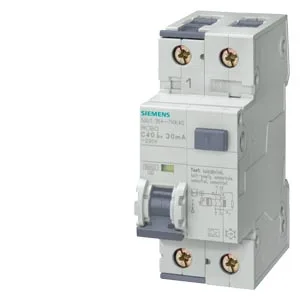
Siemens 5SU1354-4KK16 — SENTRON RCBO, 16 A C-curve, super resistant K
This is the 'super resistant K' variant, designed for environments with aggressive atmospheres — think offshore platforms, chemical plants, or coastal turbine nacelles where standard RCBOs corrode within a season. It's halogen-free and silicon-free, so no outgassing issues in sealed enclosures. The thermal derating curve is published from 30 °C to 70 °C: 16 A at 30 °C, dropping to 12.32 A at 70 °C. That matters when you pack these into a crowded panel — you don't guess the de-rate; you read the line.
Two modular-width units (36 mm wide) snap onto standard DIN rail. Depth is 77 mm, installation depth 70 mm — fits most distribution boards without a deep enclosure. IP20 rating applies only when the distribution board is installed with connected conductors — this is a panel-internal device, not for standalone outdoor use.
The C-curve (tripping characteristic class C) means magnetic trip between 5 and 10 times In — 80 to 160 A for this 16 A unit. That's the standard choice for motor circuits, small transformers, and lighting with inrush. For residential or purely resistive loads, a B-curve would trip sooner; for heavy motor starts, a D-curve would ride through better. C-curve is the workhorse for mixed industrial panels. The 20 kA per IEC 60947-2 applies when the device is used as an industrial circuit breaker — that's the number for selectivity studies and SCCR compliance in machinery panels. The -40 °C low end is rare for an RCBO — most stop at -25 °C. That makes this unit suitable for unheated enclosures in cold climates or refrigeration plants. The 75 °C maximum is the storage/transport limit; the derated current at 70 °C (12.32 A) is the operating limit.