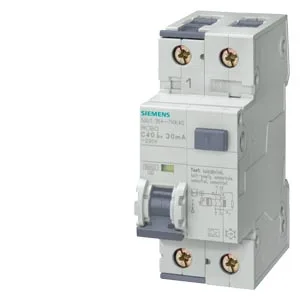
The Siemens 5SU1354-4KK20 is a SENTRON RCBO combining overcurrent protection and residual current detection in a single 2-module-width (36 mm) package. It's a 1P+N device with Type F residual current sensitivity — meaning it's designed for circuits where variable-speed drives or other frequency converters might generate smooth DC fault currents or mixed-frequency residuals that a standard Type A would miss. That dual rating gives you flexibility in specifying for different national standards or fault-level requirements at the panel design stage.
Full rated current of 20 A holds only up to 30 °C ambient. At 40 °C it's 18.8 A, at 50 °C it's 17.4 A, and at 70 °C it drops to 14.6 A. If this RCBO sits in a crowded enclosure with other heat-generating devices, check the actual ambient around the device — the published derating curve lets you calculate whether you need to upsize the breaker or improve ventilation. The IP20 rating applies only when the distribution board is installed and conductors are connected — it's not a standalone ingress protection figure for exposed mounting.
The device is classified as energy limitation class 3, which governs let-through energy during a fault — relevant for coordinating with downstream equipment.