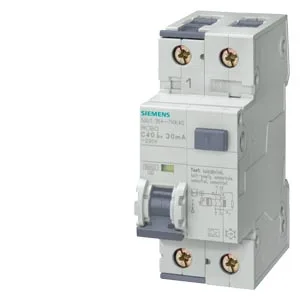
It protects a single-phase final subcircuit against both earth leakage and overload/short-circuit, with the C-curve tripping characteristic meaning it holds 5–10× rated current momentarily, suited for motor and lighting loads with moderate inrush. The 32 A rating at 30 °C derates to 24.64 A at 70 °C — that thermal curve is the real-world ampacity you need for the panel ambient, not the label number. The higher IEC figure applies when the device is used as a distribution breaker in industrial panels; the EN figure governs domestic/commercial final circuits. The super resistant K designation means the housing and internal materials are formulated for higher chemical resistance and thermal stability — relevant in aggressive environments like wastewater treatment, chemical processing, or outdoor enclosures where standard RCBOs may degrade. The IP20 rating is typical for enclosed distribution boards; the device is not intended for wet or dust-laden exposure without an outer cabinet.
Snap-on mounting for DIN rail EN 60715, any position. Halogen-free and silicon-free construction — important for panels in high-reliability or corrosive environments where outgassing from a fault could damage adjacent electronics or cause contact corrosion.