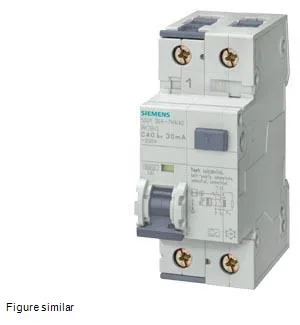
It carries a Type B tripping characteristic, so it trips on short-circuit currents between 3 and 5 times the rated current — standard for general-purpose residential and commercial final circuits where no special inrush or high-harmonic loads are present. Rated 40 A at 30 °C ambient, the part is designed for 50 Hz supply systems at 230/240 V AC.
Two breaking capacity ratings are listed: 10 kA according to EN 60898 (the standard for MCBs and RCBOs in household and similar installations) and 15 kA according to IEC 60947-2 (the standard for low-voltage switchgear and controlgear). Both ratings are at 230/240 V AC.
Temperature derating — the real current rating
The 40 A rating holds only at 30 °C ambient. Above that, the continuous current must be derated: 37.6 A at 40 °C, 36.4 A at 45 °C, 34.8 A at 50 °C, 32.4 A at 55 °C and 60 °C, 30.8 A at 65 °C, and 29.2 A at 70 °C.
This RCBO occupies 2 modular width units (MW) on a DIN rail — 36 mm wide, 90 mm high, 77 mm deep, with an installation depth of 70 mm. Supply can enter from either the top or bottom, which simplifies wiring in tight enclosures.
Construction and compliance
Pollution degree 2 (non-conductive pollution only) and overvoltage category III (fixed installation with downstream sub-distribution) are the rated environmental conditions. Surge voltage resistance is 4 000 V, insulation voltage (Ui) is 264 V.