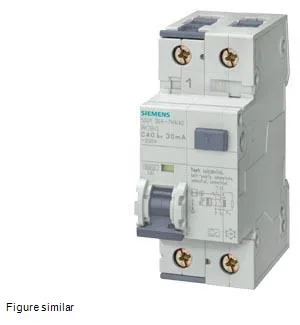
The Type A residual current detection catches pulsating DC fault currents up to the rated sensitivity, which is what you get from single-phase rectifiers in switched-mode supplies or variable-speed drives.
The 16 A rating at 30 °C is the baseline; at 40 °C it derates to 15.2 A, and at 70 °C it drops to 12.32 A. If this RCBO sits in a crowded enclosure where ambient hits 50 °C, expect 14.4 A continuous — plan the load accordingly. The B curve means magnetic trip at 3–5× In (48–80 A), so it's a fit for lighting circuits, socket outlets, and general-purpose distribution rather than motor starts that draw 6–10× FLA. The design carries 'short-time delayed G, super resistant K' — the G characteristic introduces a deliberate delay to tolerate brief surge currents (like capacitor inrush or transformer magnetising), while the K variant is built for higher mechanical and thermal endurance in frequent-switching applications. This isn't a generic domestic RCBO; it's rated for industrial panel duty where nuisance tripping costs line time. The 77 mm depth (70 mm installation depth) fits standard 18 mm-module distribution boards with room for wiring.