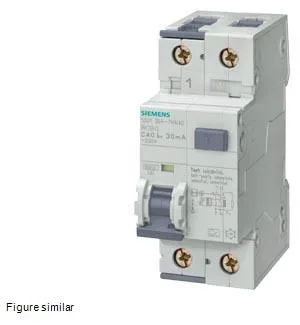
What this RCBO is and what the ratings mean
The Siemens 5SU1354-7LB25 is a 1P+N RCBO from the SENTRON family — a combined residual-current device and miniature circuit breaker in one 36 mm wide, 2-module-width unit. It protects a single phase plus neutral against overload, short-circuit, and earth leakage, and mounts on a standard DIN rail in any position. Rated 25 A at 30 °C with a C-curve tripping characteristic, meaning it holds up to 5× rated current for magnetic trip — typical for mixed resistive and moderate inductive loads like small motor circuits, lighting banks, and control transformers. The thermal derating table is provided: 23.5 A at 40 °C, 22.75 A at 45 °C, 21.75 A at 50 °C, 20.25 A at 55 °C and 60 °C, 19.25 A at 65 °C, and 18.25 A at 70 °C. If your panel ambient runs above 30 °C, size the branch circuit against the derated value, not the 25 A nameplate. Breaking capacity is 10 kA per EN 60898 (the household standard) and 20 kA per IEC 60947-2 (the industrial standard). The 20 kA figure gives headroom for high-fault locations near a transformer or in an industrial distribution board where prospective short-circuit current exceeds 10 kA. Insulation voltage (Ui) is 264 V, surge voltage resistance is 4 000 V, and overvoltage category is III — suitable for fixed-installation downstream of the main distribution board. The design variant is short-time delayed G (residual-current element with intentional delay to coordinate with downstream RCDs) and super resistant K (high immunity to nuisance tripping from surge currents and voltage spikes). Energy limitation class is 3, which means it limits let-through energy to a low level during a fault — reduces arc flash and downstream component stress.
Integration and mounting
Occupies 2 modular width units (36 mm) on a DIN rail. Installation depth behind the panel is 70 mm; the overall depth including terminals is 77 mm. Height is 90 mm. Supply can enter from top or bottom — no orientation restriction. IP20 rating applies only when installed in a distribution board with connected conductors; the device itself is not sealed for exposed mounting. Halogen-free and silicon-free construction — important for panels in environments where outgassing from a fault could corrode nearby contacts or where clean-room / food-grade specifications apply. Pollution degree 2 (normally non-conductive, occasional condensation). Test circuit requires a minimum of 195 V to operate the test button — verify the phase-to-neutral voltage at the installation point meets this threshold for periodic functional testing.
