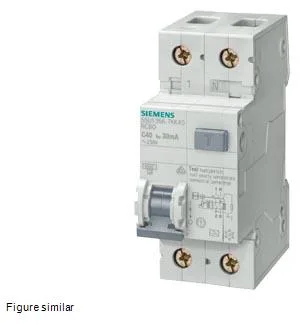
The Siemens 5SU1356-0DV16 is a combined residual-current device and miniature circuit breaker (RCBO) — one unit does both the earth-leakage protection and the overcurrent/short-circuit protection. The B-curve 16 A rating trips instantaneously between 3 and 5 times rated current (48–80 A), which is the usual choice for resistive and general-purpose loads with modest inrush — lighting, socket outlets, small appliances. The 1+N-pole construction switches and protects the phase only; the neutral is switched but not protected. The 70 mm width (about 4 module spaces) and pig-tail connection are the standard form factor for DIN-rail mounting in a consumer unit or sub-distribution board.
The 70 mm width (DIN-rail footprint) occupies four 17.5 mm module spaces in a distribution board or enclosure. The pig-tail connection is the factory-fitted neutral tail that connects to the neutral busbar — no separate neutral link to buy. For a panel builder or wireman, the key fit check is the busbar pitch and the neutral bar position; the pig-tail length is standard for domestic consumer units.
Deployment context
This RCBO is designed for DIN-rail mounting in a distribution board or consumer unit — typical deployment is in residential, commercial, or light industrial final circuits where both earth-leakage and overcurrent protection are required in a single module. The Type AC classification means it is suited for circuits with sinusoidal AC residual currents (standard lighting, socket outlets, general appliances). It is not suitable for circuits with electronic loads that generate pulsating DC residual currents (e.g., washing machines, LED drivers, EV chargers) — those require a Type A or Type F device.