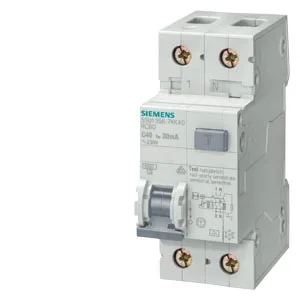
The Siemens 5SU1356-0DV40 is a combined residual-current and miniature circuit breaker (RCBO) — an FI/LS protector in Siemens' own shorthand. It packs a 40 A B-curve overcurrent trip and a 30 mA Type AC residual-current detection into a single 1+N-pole module with a pig-tail neutral connection.
The 30 mA residual sensitivity is the mandatory level for socket-outlet circuits in most IEC 60364-based wiring regulations, providing personal protection against direct contact. That covers the vast majority of domestic and office circuits, but not pulsating DC or smooth DC faults — those need Type A or Type F devices. If your load includes variable-speed drives, LED drivers, or single-phase rectifiers, verify the residual waveform before specifying this unit.
The 70 mm depth (D=70MM) is the dimension from the DIN-rail mounting surface to the front of the device — standard for Siemens 5SU series RCBOs. The pig-tail neutral connection exits the bottom; plan your wiring channel to accommodate the factory-fitted neutral lead rather than a busbar pickup. The 1+N-pole format occupies a single module width on the DIN rail, matching the standard 18 mm per pole spacing.