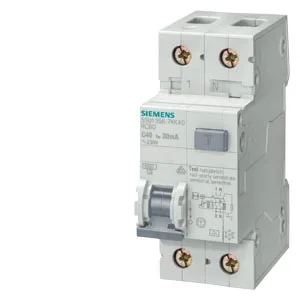
It protects a single-phase final subcircuit against overload, short-circuit, and earth leakage. The 1P+N construction switches the line conductor and breaks the neutral, with one protected pole. This is the instantaneous (non-time-delayed) version, so it trips on residual current without intentional delay — standard for general-purpose socket and lighting circuits where no upstream selectivity is needed. The breaking capacity is 6 kA per EN 60898 for domestic-type coordination and 15 kA per IEC 60947-2 for industrial installation — meaning it can clear a fault up to 15 kA at the supply terminals without welding its contacts. That dual rating gives the specifying engineer flexibility: the 6 kA figure satisfies most residential and commercial boards; the 15 kA figure covers industrial distribution where fault current is higher.
Temperature derating — the real current you get
The 20 A rating is only valid at 30 °C ambient inside the panel. At 40 °C it derates to 18.8 A; at 50 °C to 17.4 A; at 60 °C to 16.2 A; and at 70 °C to 14.6 A. The derating curve is published; factor it into the load calculation before committing the BOM line.
Depth is 77 mm, installation depth 70 mm.