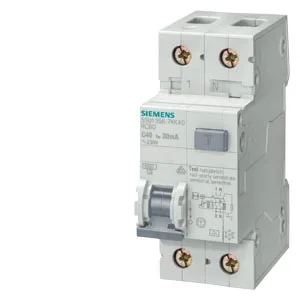
What it is and what it does
The Siemens 5SU1356-1KK32 is a SENTRON RCBO — a combined residual-current circuit breaker and overcurrent protection device in a single 2-module-width (36 mm) package. It protects a 1P+N circuit (switched phase, switched neutral) at 230/240 V AC, 50 Hz, with a Type C tripping characteristic for moderate inrush loads like small motors and lighting banks. Rated 32 A at 30 °C ambient, the unit derates to 30.4 A at 40 °C, 28.8 A at 50 °C, and 24.64 A at 70 °C. Breaking capacity is 6 kA per EN 60898 (the standard for household-type MCBs) and 15 kA per IEC 60947-2 (the industrial standard for circuit breakers), giving it dual certification for both residential and light-industrial distribution boards.
Mounting and integration
Snaps onto DIN rail (35 mm) — 2 module-widths wide at 36 mm, 77 mm deep, 90 mm tall. Installation depth is 70 mm, so it clears a standard 80 mm deep enclosure back wall. Supply can enter from top or bottom; the neutral is switched and the phase is protected. Mounting position is unrestricted. IP20 rated when installed in a distribution board with conductors connected — this is a panel-interior device, not for wet or outdoor locations without an outer enclosure. Halogen-free and silicon-free construction, important for clean-room or high-reliability environments where outgassing must be minimized.
Key ratings and what they mean for fit
Overvoltage category III and pollution degree 2 — suitable for fixed-installation distribution boards where transient overvoltages from the mains are expected (e.g., building supply side, not downstream of a transformer). Surge voltage resistance rated at 4 000 V, insulation voltage 264 V — the device withstands the impulse voltages typical of a 230/240 V TN system. Energy limitation class 3 — limits the let-through energy during a short-circuit, reducing stress on downstream wiring and connected equipment. Test voltage minimum 195 V — the integral test button for the residual-current function operates reliably down to that voltage, so periodic testing is valid even on a lightly loaded circuit. Ambient temperature range -40 °C to 75 °C — storage and operation cover most industrial enclosures and unheated substations.
