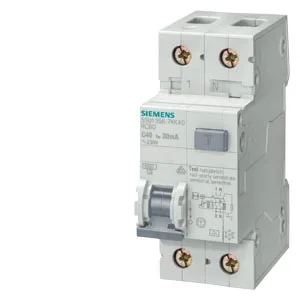
The Siemens 5SU1356-1KV16 is a combined residual-current device and miniature circuit breaker — an FI/LS-protector — in a single 1+N-pole unit. It carries a Type AC (wave-shaped) residual-current detection with a 30 mA trip threshold, a 6 kA short-circuit breaking capacity, and a C-curve 16 A overcurrent characteristic. The 70 mm depth fits standard DIN-rail distribution boards.
Deployment context
Snap-on DIN-rail mounting for enclosure integration. The 1+N-pole format (switched phase + switched neutral) is required in many national wiring regulations for circuits where the neutral must be isolated on fault. Type AC detection covers sinusoidal AC residual currents — the common case for resistive and inductive loads without power electronics. If your circuit includes variable-speed drives, LED lighting, or other non-linear loads generating pulsed DC fault currents, a Type A or Type F device would be needed instead.