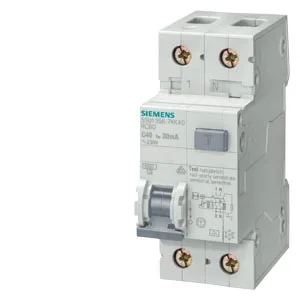
The Siemens 5SU1356-1KV20 is an FI/LS-protector — a combined residual-current device (RCD) and miniature circuit breaker (MCB) in one DIN-rail module. It's Type AC (sensitive to sinusoidal AC fault currents), with a rated residual operating current IΔn of 30 mA and a short-circuit breaking capacity of 6 kA. The 1+N-pole configuration switches the line and monitors the neutral; the C-curve 20 A thermal-magnetic trip protects against overcurrent and short circuits on general-purpose and motor-starting loads.
The 70 mm depth (D=70mm) is the standard for Siemens 5SU series RCBOs — it fits the same DIN-rail footprint as the 5SL MCBs and 5SM RCDs. The 1+N-pole width is 2 module spaces (36 mm on a standard DIN rail). Wire-up is straightforward: line in on the top terminal, load out on the bottom, neutral bar connected through the device. No special busbar needed if you're using the Siemens 5ST3 comb busbar system.