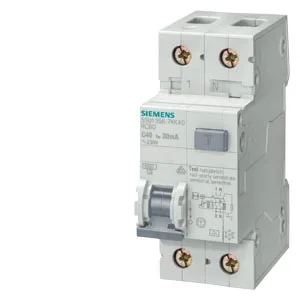
The Siemens 5SU1356-6KV40 is a combined residual-current and miniature circuit breaker (FI/LS protector) in a single 70 mm wide unit. It integrates Type A residual-current detection at 30 mA with a B-curve overcurrent trip set at 40 A, all rated for a 6 kA breaking capacity. This is the 1+N-pole variant, meaning it switches and protects the phase conductor while the neutral is switched but not protected against overcurrent — standard for single-phase final circuits where neutral protection is not required by local code.
The B-curve overcurrent characteristic (40 A rated current, In) means the magnetic trip activates at 3 to 5 times In (120–200 A), suited for resistive and general-purpose loads with moderate inrush — think lighting banks, socket outlets, small heaters. The 70 mm width (4 module spaces) is wider than a standard single-module MCB — account for this in DIN-rail layout and enclosure fill calculations.