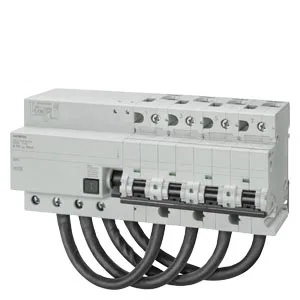
It occupies 8 module widths on a DIN rail, which is the standard 144 mm — a factor to check against enclosure fill limits when retrofitting into an existing panel.
The 32 A rating governs the thermal overload element; continuous load should not exceed 32 A, and the D curve's magnetic threshold (320–640 A instantaneous) clears hard faults without coordination issues downstream. Type AC residual current detection handles sinusoidal AC earth faults only. For variable-speed drives, UPS outputs, or LED lighting with rectifiers, a Type A or Type F RCD would be required — Type AC will not reliably detect the fault waveforms those loads generate. The 300 mA residual sensitivity is a fire-protection level, not personnel protection (30 mA is the threshold for direct contact). This unit is intended for sub-distribution or feeder circuits where the earth leakage is expected to be higher than 30 mA but still needs ground-fault detection to prevent cable overheating and fire risk.
Snap-on DIN rail mounting per EN 60715. At 8 modules (144 mm), it occupies a full row on a standard 12-module distribution board. Verify the busbar comb arrangement — 4-pole RCBOs require a 4-conductor busbar with the neutral pole switched. The neutral pole is on the right-hand side (phase sequence L1-L2-L3-N).
This RCBO combines overcurrent protection (MCB function) and residual current protection (RCD function) in a single 4-pole device, saving one module width compared to separate MCB + RCD units. The 32 A D curve with 300 mA Type AC residual covers the common specification for motor feeder circuits in commercial and light industrial sub-distribution boards where earth leakage is monitored for fire prevention rather than personnel shock protection.