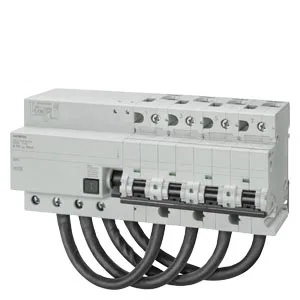
The Siemens 5SU1644-6WK82 is a 4-pole selective RCBO (residual current circuit breaker with overcurrent protection) from the SENTRON family, rated 125 A at AC with a Type A residual-current sensitivity of 300 mA and a 10 kA breaking capacity per EN 60898. The selective design (marked as such) means it coordinates with downstream devices — it holds in during a fault on a branch so only the faulted circuit clears, keeping the rest of the panel live. That's the difference between a nuisance blackout and a targeted trip. Rated insulation voltage is 440 V, surge voltage resistance is 4 kV, and it's built for overvoltage category III — standard for fixed-installation distribution boards in commercial and industrial buildings.
At 40 °C the rating is 115.62 A, at 50 °C it is 106.25 A, and at 60 °C it is 96.25 A. For motor-heavy circuits you'd typically reach for a C or D curve, but for lighting, heating, or mixed distribution this B-curve gives good protection without nuisance trips. Type A residual current detection handles pulsating DC fault currents — the kind you get from single-phase rectifiers in switched-mode supplies, VFDs, and LED drivers. That's the standard choice for modern industrial panels where electronics are everywhere. The 300 mA rated fault current is a fire-protection level, not a personnel-protection level (that's 30 mA). This RCBO is meant for branch-circuit protection where the goal is to catch arcing faults before they start a fire, not to protect someone touching a live conductor.
Where it mounts and how it fits the panel
This is normal for indoor panel mounting; if the board lives in a washdown area, the enclosure handles the IP rating, not the RCBO itself. Mounting position is any orientation, so you can lay it sideways or upside down if the panel layout demands it — no derating needed for the position itself, though ambient temperature still governs the current rating.
The 5SU9304-1KK32 is also a 4-pole SENTRON RCBO but typically a lower-current variant — the 5SU1644-6WK82 at 125 A sits at the high end of the family. The 5SU9304 series uses a different housing width (fewer modular units) and may have a different breaking capacity or residual-current type. If you're swapping one for the other, check the physical fit first: the 5SU1644-6WK82 at 11 MW (198 mm) is wider than most 4-pole RCBOs in the SENTRON range, so it needs more DIN-rail real estate.
What compliance and documentation comes with it
The RCBO carries the F designation per EN 61346-2 and IEC 81346-2, which is the standard function code for circuit protection devices. This helps with consistent labeling in panel documentation and maintenance logs. That's a meaningful spec for coordination studies. The operating frequency is 50/60 Hz, covering both standard mains frequencies worldwide. The minimum test voltage of 100 V means the test circuit can verify the RCD function even on a low-voltage supply.