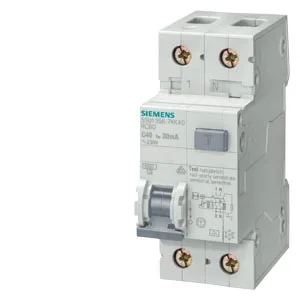
The Siemens 5SU1653-0KV20 is a combined residual-current device and miniature circuit breaker — an FI/LS protector — in a single 1+N-POL module, Type AC, with a rated residual current IΔn of 300 mA, a B-curve trip characteristic at 20 A, and a short-circuit breaking capacity of 4.5 kA. It fits a standard DIN-rail enclosure alongside other modular protection devices, saving a module width compared to separate RCD and MCB units. The 70 mm depth (D=70mm) is typical for this class and clears most shallow consumer-unit or panel enclosures without gland-plate interference.
The B-curve at 20 A means the magnetic trip operates between 3 and 5 times In (60–100 A) — suited for resistive and general-purpose loads with modest inrush, like lighting banks, control transformers, or heater circuits. The 300 mA residual-current threshold is a delayed-action Type AC trip, designed to detect sinusoidal AC earth faults; it is not intended for pulsating DC or smooth DC fault currents (Type A or F would be required for drives, UPS, or EV chargers). In a panel, verify the upstream SCCR coordination so the 4.5 kA rating is not exceeded under a bolted fault.