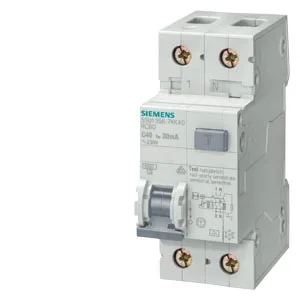
The Siemens 5SU1653-1KV20 is a combined residual-current device and miniature circuit breaker (RCD/MCB), known as an FI/LS protector. It combines Type AC residual current detection at 300 mA with a C-curve overcurrent trip at 20 A, all in a single 1+N-P module. The 4.5 kA short-circuit breaking capacity handles typical domestic and light commercial fault levels.
The 300 mA residual sensitivity is a delayed (S-type) characteristic, intended as a fire-protection or selective earth-leakage device upstream of 30 mA RCDs. It will not trip on the leakage from a single person touching a live conductor; that is the 30 mA level. The D=70 mm dimension refers to the depth behind the panel, so verify enclosure depth if retrofitting into a shallow consumer unit.
This is a 1+N-P module — it switches and protects the line conductor only; the neutral is switched but not protected. If the fault level exceeds 4.5 kA, an upstream backup fuse or MCB is required.