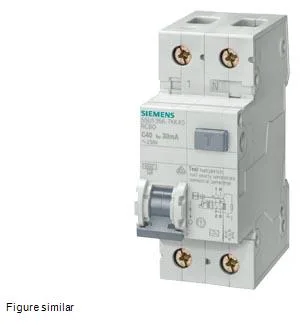
The Siemens 5SU1653-6KV13 is a combined residual-current and overcurrent protective device — an RCBO in a 1+N-Pol format.
Rated residual current IΔn = 300 mA: this is a higher threshold than the 30 mA used for personal shock protection. It is selected for fire-prevention or equipment-protection duty where nuisance tripping from cable capacitance or surge suppressors must be avoided — common on long cable runs or in industrial sub-distributions where the upstream RCD is 300 mA and coordination is required. Breaking capacity 4.5 kA: this is the standard short-circuit rating for domestic and light-commercial final circuits in many European installations. For higher prospective fault levels (e.g. close to a transformer), an upstream back-up fuse or MCB with higher kA rating must coordinate. B-curve 13 A: the magnetic trip operates between 3 and 5 times rated current (39–65 A), suited for resistive and general-purpose loads — lighting, socket outlets, small appliances. Not ideal for motor starting (where C- or D-curve is preferred) but fine for most final circuits in a distribution board.
Snap-on DIN-rail mounting, 70 mm width (four TE). The 1+N-Pol format switches the line conductor and disconnects the neutral, which is standard for single-phase final circuits in TN or TT systems. The Type A marking means it detects residual pulsating DC — required for circuits with single-phase rectifiers, switching power supplies, or electronic loads that can blind a Type AC device.