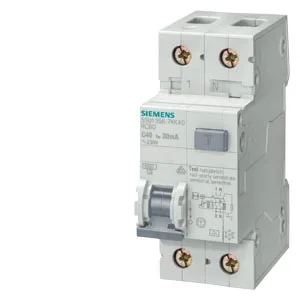
The Siemens 5SU1653-6KV32 is a combined residual current device and miniature circuit breaker (RCBO) — an FI/LS protector in Siemens' own shorthand. It packs a Type A residual-current module (300 mA trip threshold) and a B-curve overcurrent trip (32 A, 4.5 kA breaking capacity) into a single 70 mm-wide, 1+N-pole package. Type A means it catches pulsating DC faults on top of sinusoidal AC leakage — the kind a VFD or single-phase rectifier load can dump onto the PE conductor. The 300 mA threshold is set for fire protection or circuit integrity rather than personnel shock protection (30 mA is the human-safety threshold); you spec this where the load's natural leakage is too high for a 30 mA device and the goal is arc-flash prevention or equipment protection.
The B-curve at 32 A means the magnetic trip fires between 3× and 5× rated current (96 A to 160 A) — suited for resistive and general-purpose loads, lighting circuits, and small motor starters where inrush isn't extreme. The 4.5 kA breaking capacity (Icn per EN 60898) is the standard domestic/commercial short-circuit rating; it safely interrupts a fault up to 4.5 kA at the rated voltage without welding the contacts. The 1+N-pole construction switches both line and neutral, with overcurrent protection on the line pole only — common for single-phase final circuits in TN-S or TT earthing systems. At 70 mm wide (roughly 4 DIN modules), it occupies standard DIN-rail space; leave clearance for the test button and wiring gutters.
This class of combined RCD/MCB is the go-to for final subcircuits in distribution boards — lighting, socket outlets, small appliance circuits — where you need both earth-leakage and overcurrent protection in one DIN-rail slot. The Type A characteristic makes it mandatory for circuits feeding single-phase loads with electronic rectification (washing machines, heat pumps, EV chargers, VFD-fed pumps) where a plain Type AC RCD can blind itself to pulsating DC fault current. The 300 mA threshold is typical for fire-protection risers or circuits supplying fixed equipment where nuisance tripping on a 30 mA device would be unacceptable.