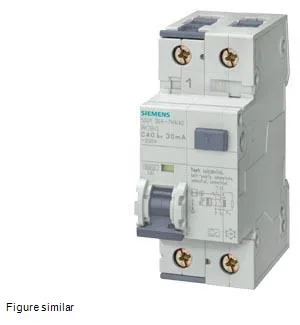
The Siemens 5SU1654-0KV10 is an FI/LS combination unit — an RCBO that integrates a Type AC residual-current device (IΔn 300 mA) and a 10 A B-curve miniature circuit breaker into a single 1+N-pole module.
The 300 mA residual sensitivity is a Type AC device, meaning it detects sinusoidal AC earth faults only; it is not suitable for pulsating DC or smooth DC fault currents (those call for Type A or Type F).
Panel integration
The 1+N-pole form factor occupies a single DIN-rail module width (roughly 18 mm per pole, so 36 mm total for the 1+N). The D=70 mm dimension refers to the depth from the DIN rail mounting surface to the front of the enclosure — standard for flush-mounting in a consumer unit or distribution board. Wire-up is conventional: line and neutral through the top terminals, load out the bottom; the neutral is switched and protected internally.