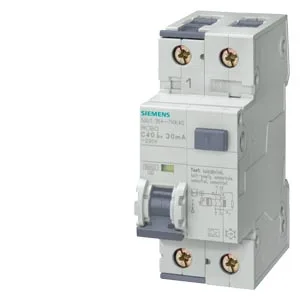
It integrates a Type A residual-current device rated at 300 mA IΔn with a 10 kA short-circuit breaking capacity and a 1+N-pole thermal-magnetic miniature circuit breaker in a B-curve characteristic, 10 A rated current.
The 300 mA IΔn (rated residual operating current) makes this unit suitable for circuits where a lower 30 mA sensitivity would cause nuisance tripping — typically final subcircuits supplying fixed equipment with natural leakage, or distribution boards where earth-leakage protection is required but personnel protection is covered upstream. The Type A designation means it detects pulsating DC residual currents as well as sinusoidal AC, which is essential for circuits with single-phase rectifiers, switched-mode power supplies, or variable-speed drives that generate pulsed DC fault currents. The B-curve (10 A) trips instantaneously at 3–5× rated current (30–50 A), intended for resistive and general-purpose loads such as lighting, socket outlets, and control transformers — not for motor starting or transformer inrush where a C- or D-curve would be needed.
Deployment context
The combined form factor saves one module width compared to a separate RCD and MCB. The PSE/SSF marking indicates compliance with the Polish PSE standard and the Swedish SSF standard, confirming acceptance in those markets for residential and commercial panel builds.