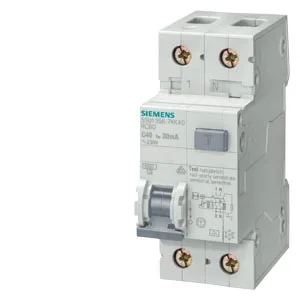
What this RCBO is and what it does
The Siemens 5SU1656-0KK10 is a SENTRON RCBO — a combined residual-current device and miniature circuit breaker in one 2-module-wide (36 mm) package. It protects a single-phase final subcircuit against both overload/short-circuit and earth leakage in one unit, saving a DIN-rail position over separate MCB+RCCB. Rated 230/240 V AC at 50 Hz, it carries a B-curve tripping characteristic (instantaneous trip between 3 and 5 times rated current) and a 30 mA residual-current sensitivity of type AC — meaning it detects sinusoidal AC fault currents only, not pulsating DC or smooth DC. That makes it a fit for general-purpose socket-outlet circuits, lighting, and small appliance loads where no variable-speed drives or electronic loads are downstream. Breaking capacity is 6 kA per EN 60898 (the household-standard) and 15 kA per IEC 60947-2 (the industrial-standard). The higher 15 kA figure is the one that matters when this RCBO sits in an industrial panel with a transformer-fed supply capable of delivering higher prospective fault current — it tells you the unit can safely interrupt a fault up to 15 kA without welding its contacts or rupturing the case.
Temperature derating — the real-world current rating
The 10 A nominal rating only holds at 30 °C ambient inside the enclosure. At 40 °C it's 9.5 A; at 50 °C it's 9 A; at 60 °C it's 8.5 A; at 70 °C it's 8 A. If your panel runs hot — say 50 °C inside a sealed stainless enclosure on a production floor — you need to size the upstream protective device for the derated figure, not the nameplate 10 A. The full derating curve is published for every 5 °C step from 30 °C to 70 °C.
Panel fit and mounting
Snaps onto 35 mm DIN rail per EN 60715. At 36 mm wide (2 modular units), it occupies two standard 18 mm positions. Depth is 77 mm, installation depth 70 mm — check your enclosure's internal clearance if you're retrofitting into a shallow gland-plate area. Supply can enter from top or bottom; the neutral is switched (1P+N, not 2P). Mounting position is any, so it works equally well in vertical or horizontal DIN-rail layouts. IP20 protection applies only when the distribution board is installed with connected conductors — the busbar stabs and terminals are live when the front cover is off, so standard finger-safe terminal shrouds or a dead-front enclosure are expected.
Compliance and approvals
Designed to EN 60898 and IEC 60947-2, with overvoltage category III and pollution degree 2 — the usual for fixed-installation final circuits in commercial and light-industrial buildings. Halogen-free and silicon-free construction matters if the panel is in a clean room or a corrosive environment where outgassing could contaminate optics or contacts. Energy limitation class 3 means it limits let-through energy to a low level during a fault, which helps with downstream coordination.
