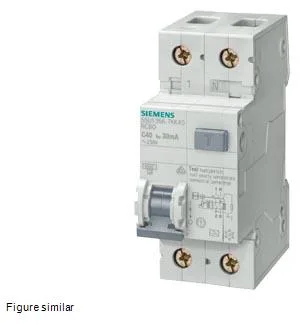
The Siemens 5SU1656-0KV06 is a combination FI/LS protector (RCBO) — a single module that packs both overcurrent protection and residual current protection into a 70 mm wide, 1+N-pole package. The 'Type AC' designation means it detects sinusoidal AC residual currents only; it's the standard choice for general-purpose circuits where pulsed or DC fault currents aren't expected. The 6 A B-curve thermal-magnetic trip handles short-circuit and overload protection for lighting or small motor loads, while the 300 mA rated residual current (IΔn) provides earth-fault protection — typically specified for circuits feeding socket outlets or fixed equipment in commercial or residential distribution boards.
Because this is a current-production Siemens RCBO, lead times typically track the factory build cycle — no unusual supply constraints are expected for this standard 6 A / 300 mA variant. Submit an RFQ for a firm delivery commitment.
The neutral pole is switched and protected — the device opens both line and neutral on a fault, which is the requirement for TN-S and TT earthing systems. The Type AC residual current detection is the entry-level class; if the downstream load includes VFDs, LED drivers, or other electronics that generate pulsed or high-frequency leakage, a Type A or Type F device would be needed instead.