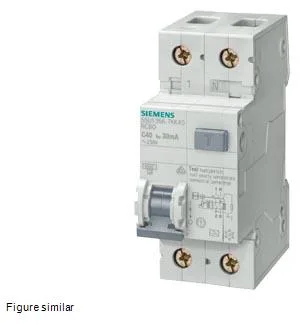
The Siemens 5SU1656-0KV10 is a combined residual-current device (RCD) and miniature circuit breaker (MCB), known as an FI/LS-protector. It combines Type AC earth-leakage detection with a 10 A B-curve overcurrent trip in a single 1+N-pole unit, rated for a 6 kA short-circuit capacity. The 300 mA residual sensitivity (IΔN) means it is sized for equipment or circuit protection rather than personnel shock protection — it will not trip on the small leakage currents a person might draw, making it suitable for circuits where nuisance tripping from capacitive or filter leakage is a concern.
The B-curve (10 A) means the magnetic trip operates between 3× and 5× rated current (30–50 A), so it is a good fit for resistive and general-purpose loads — lighting, socket outlets, control transformers — where inrush is moderate. The 300 mA residual sensitivity places this unit in the Type AC category, meaning it detects sinusoidal AC earth faults only — not pulsating DC or smooth DC faults. For circuits with variable-speed drives, LED drivers, or other non-linear loads that can generate pulsating DC leakage, a Type A or Type F device would be needed instead.
The 70 mm depth (D=70mm) is the dimension from the DIN-rail mounting surface to the front of the device — standard for Siemens 5SU series RCBOs. The 1+N-pole format means it switches the phase and opens the neutral, with the neutral pole not fused. In a typical domestic or light-commercial consumer unit, this unit occupies a single module width (about 18 mm per pole, so 2 modules for 1+N).