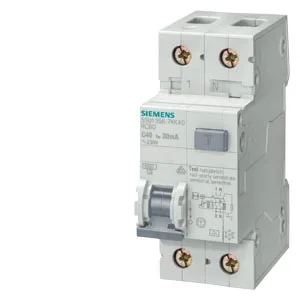
That means it protects a circuit against both overload/short-circuit (the C-curve handles moderate inrush, typical for motor starters and lighting banks) and earth-leakage faults (the AC type detects sinusoidal AC residual currents). The 30 mA sensitivity is the standard for personal protection against indirect contact in TN and TT systems. The higher IEC figure matters when the RCBO sits downstream of a transformer or in an industrial panel where prospective fault current can exceed the domestic 6 kA limit. The 15 kA rating gives it headroom for coordination with upstream devices in a selective scheme.
In a real panel — say 40 °C to 50 °C — the continuous current must be derated: 9.5 A at 40 °C, 9 A at 50 °C, 8.5 A at 60 °C, and 8 A at 70 °C. Plan the load at the derated value for the expected ambient, not the 30 °C nameplate figure. Mounting position is unrestricted — install it any orientation in the distribution board.