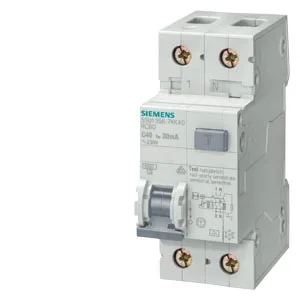
The 'FI/LS' label is the German shorthand for this combo device. Type A sensitivity (300 mA IΔn) means it detects pulsating DC fault currents on top of sinusoidal AC — the standard for circuits feeding single-phase electronics, inverters, or variable-speed drives where a pure AC-sensing RCD might not trip on a half-wave fault. The B-curve 6 A overcurrent characteristic trips instantaneously at 3–5× rated current (18–30 A), so it's sized for resistive and general-purpose loads like lighting, small appliance circuits, or control transformers — not high-inrush motor or welding loads where a C or D curve would be needed.
The 70 mm depth (D=70 mm) is the standard for Siemens 5SU6 series devices, so it fits alongside other Siemens modular protection gear without a step-out. The 1+N-pole format switches the live and monitors neutral; the neutral is switched internally but not protected against overcurrent.