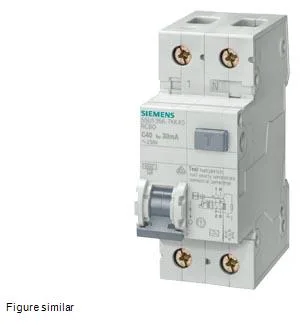
The Siemens 5SU1656-7KV40 is a combined residual-current device (RCD) and miniature circuit breaker (MCB) in one unit — an FI/LS protector. The Type A designation means it detects sinusoidal AC fault currents plus pulsating DC fault currents, which covers most modern electronic loads (switched-mode power supplies, variable-speed drives, LED drivers) that a pure AC-sensitive Type AC device would miss. The 300 mA residual rating is sized for protection against fire risk rather than direct personal shock protection (30 mA is the threshold for that), so this unit is typically specified in circuits where the primary concern is cable insulation breakdown or slow-developing earth faults — think distribution sub-mains, lighting circuits in commercial buildings, or industrial control panels where nuisance tripping from leakage is a concern. The C 40 A overcurrent characteristic means the magnetic trip threshold is 5 to 10 times the rated current (200–400 A), so it handles motor inrush and transformer energisation without nuisance tripping, while still clearing hard short-circuits.
Deployment context
The 70 mm width (4 DIN-modules) fits standard DIN-rail enclosures. The 1+N-pole configuration switches the phase and monitors neutral, so it is suited for single-phase circuits in TN-S or TT earthing systems where neutral integrity matters. Terminal capacity accepts up to 25 mm² conductors, typical for 40 A sub-mains.