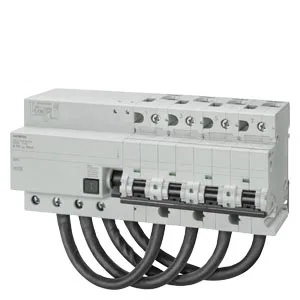
It combines a 100 A thermal-magnetic overcurrent trip (Class C characteristic) with a 300 mA residual-current detection circuit rated Type B+ — meaning it catches smooth DC fault currents, AC pulsating faults, and high-frequency AC components, not just the sine-wave faults a basic Type A handles.
The 100 A rating at 30 °C is the headline number, but the derating curve tells the real story for a warm panel: at 40 °C it carries 92.5 A, at 50 °C it drops to 85 A, and at 60 °C it's down to 77 A. For a 400 V three-phase system with a transformer impedance giving a prospective fault current of, say, 6 kA, this RCBO has adequate headroom. If your service entrance can deliver 18 kA, you need a current-limiting upstream breaker or a higher-rated device. Type B+ residual-current detection covers smooth DC, AC pulsating, and high-frequency components. The 300 mA threshold is common for general protection.
Deployment context
IP20 rating is standard for inside a distribution board. Connection top or bottom. Depth 77 mm, installation depth 70 mm.