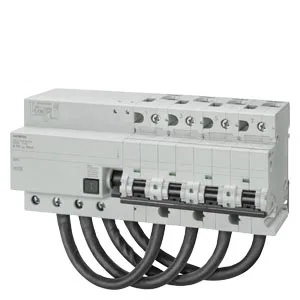
The Siemens 5SU1674-8BK81 is a 4-pole SENTRON RCBO (residual current circuit breaker with overcurrent protection) rated 100 A at 30 °C with a D tripping characteristic and a 10 kA breaking capacity certified to both EN 60898 and IEC 60947-2. The 11-module-width (198 mm) body and 77 mm depth fit standard DIN-rail enclosures, but the 11 MW footprint is wider than a typical 4-pole MCB — plan your rail space accordingly.
Temperature derating — the real-world current you can count on
The 100 A rating is only valid at 30 °C ambient. At 40 °C the continuous rating drops to 92.5 A, at 45 °C to 89 A, at 50 °C to 85 A, at 55 °C to 81 A, and at 60 °C to 77 A. If your panel runs warm — and most enclosed distribution boards do — size your load against the derated figure, not the headline 100 A. The surrounding temperature influence is listed as max 95% humidity, so condensation inside the enclosure is the bigger concern than dry heat.
Approvals and compliance documentation
The insulation voltage (Ui) is rated 440 V, overvoltage category III, pollution degree 2. IP20 protection applies when installed in a distribution board with connected conductors — the enclosure itself provides the environmental seal.