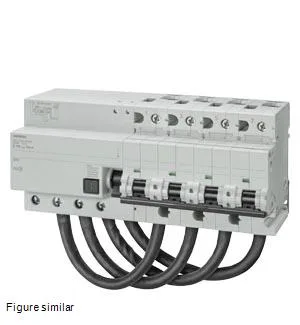
RCBO with Type B+ residual current and D-curve — what the ratings mean for the panel
The Siemens 5SU1674-8DK81 is a 4-pole RCBO (residual current circuit breaker with overcurrent protection) from the SENTRON family, combining a 100 A thermal-magnetic D-curve MCB with a Type B+ residual current device rated at 300 mA trip sensitivity. The D characteristic (10–20× In magnetic trip) is specified for loads with high inrush — transformer-fed circuits, motor starters, or welding equipment — where a B or C curve would nuisance-trip on startup. The Type B+ RCD detects AC, pulsating DC, smooth DC, and high-frequency residual currents, making it suitable for variable-speed drives, UPS systems, and EV charging infrastructure where fault currents may not be sinusoidal. The 10 kA breaking capacity is rated per both EN 60898 and IEC 60947-2, so it coordinates with downstream distribution boards and upstream MCCBs in a 400 V TN system.
Thermal derating and installation constraints
The 100 A rating holds at 30 °C ambient; at 40 °C it derates to 92.5 A, at 50 °C to 85 A, and at 60 °C to 77 A. In a sealed, uncooled enclosure — typical for a machine-tool panel or a solar combiner box — the installer must use the 40 °C or 50 °C column for conductor sizing and load scheduling. The unit occupies 11 modular width units (198 mm) on a DIN rail, with a 77 mm depth and 70 mm installation depth, so it fits standard 125 mm deep enclosures but requires 11 slots of rail space — plan the gland plate and busbar routing accordingly. Supply cord entry can be from top or bottom, which helps when the panel is pre-wired with fixed busbars. IP20 protection applies only when the distribution board is installed with connected conductors; the device itself is not rated for exposed wiring compartments.
Construction and compliance details
The super resistant K design indicates enhanced mechanical and thermal endurance for harsh environments — the housing is halogen-free and silicon-free, which matters for clean-room, semiconductor, or offshore installations where outgassing or silicone contamination must be avoided. The operating temperature range spans -40 °C to 75 °C, covering cold storage and hot attic or rooftop enclosures. Overvoltage category III and pollution degree 2 are standard for fixed-installation distribution boards. Touch protection is integrated on the terminals. The insulation voltage is rated at 440 V, matching typical 400/415 V three-phase networks.
