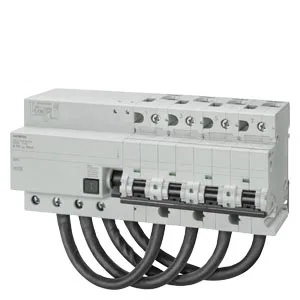
Selectivity and the Type B+ residual
The 'selective' design (S-type) means this RCBO introduces a deliberate time delay on the residual trip, so it lets a downstream RCD clear first during a ground fault. That buys you discrimination in a multi-level distribution board — a nuisance trip on a sub-panel doesn't drop the whole feeder. Type B+ residual detection covers AC, pulsating DC, smooth DC, and high-frequency AC components up to 20 kHz, which is what you need when variable-speed drives, UPS systems, or EV chargers are on the load side. Standard Type A units will miss smooth DC or high-frequency leakage; the B+ catches it and trips at 300 mA.
Thermal derating in the panel
At 40 °C it derates to 92.5 A, at 50 °C to 85 A, and at 60 °C to 77 A. If this RCBO sits in a crowded 11-MWU (198 mm wide) section of a distribution board with other heat sources, you need to check the actual enclosure ambient against the derating curve — the tabulated values are the maximum continuous current at each temperature, not a suggestion. The unit is IP20 once installed with conductors connected; that's standard for a distribution board interior, but it's not rated for wet or dusty environments.
Supply enters from top or bottom.