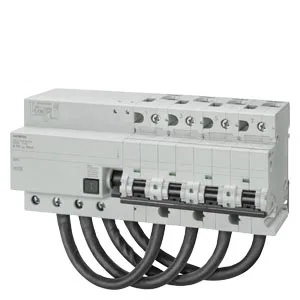
What this RCBO is and what the ratings mean for your panel
The Siemens 5SU1844-7WK82 is a SENTRON selective RCBO — a combined residual-current circuit breaker with overcurrent protection, in a 4-pole 3P+N configuration. It's rated 125 A at 30 °C ambient, with a C tripping characteristic (magnetic trip at 5–10× In, typical for motor and lighting circuits with moderate inrush). The Type A fault-current detection means it catches sinusoidal AC and pulsating DC residual currents, which covers most modern electronic loads like VFDs, switched-mode supplies, and LED drivers. Breaking capacity is 10 kA per both EN 60898 and IEC 60947-2 — that's the fault current it can safely interrupt without welding contacts or rupturing the case. For a 125 A frame, 10 kA is the standard domestic and light-commercial SCCR; if your available fault current is higher, you'll need an upstream current-limiting device or a higher-rated breaker. The 'selective' designation (S-type) means this RCBO has a deliberate short-time delay on the residual-current trip. It coordinates with downstream RCDs so that a fault on a sub-circuit trips the local device first, not this main switch. That's the difference between losing one branch and losing the whole distribution board.
Thermal derating — the real current rating at your panel ambient
The headline 125 A holds only at 30 °C. At 40 °C it's 115.62 A; at 45 °C it's 111.25 A; at 50 °C it's 106.25 A; at 55 °C it's 101.25 A; at 60 °C it's 96.25 A. If your panel runs hot — and most enclosed panels with multiple breakers do — size the load to the derated figure, not the 30 °C number. The 4-pole package dissipates heat from all three phases plus the neutral, so grouping several of these in a row without ventilation gaps will push the effective ambient higher.
DIN-rail fit and panel integration
Width is 198 mm, which is 11 width units at 18 mm per module — that's a wide device, so plan for it in your rail layout. Depth is 77 mm overall, with 70 mm installation depth behind the panel face. Height is 90 mm. Mounting position is any orientation, and supply can enter from top or bottom, which simplifies busbar routing in a crowded enclosure. IP20 rating applies once the distribution board is installed with conductors connected — it's not a sealed device, so keep it inside a cabinet. Touch protection is built in (fingertip-safe terminals per the product feature). Pollution degree 2 and overvoltage category III are standard for fixed-installation distribution boards. Halogen-free and silicon-free construction matters if the panel is in a cleanroom or a corrosive environment where outgassing could cause contact issues.
