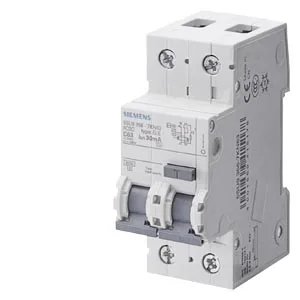
RCD-operated circuit breaker for final circuits
The Siemens 5SU9156-7VK16 is a SENTRON RCD-operated circuit breaker (RCBO) combining overcurrent and residual current protection in a single 2-module-width (36 mm) package. Rated 16 A at 30 °C with a C tripping curve, it handles the inrush of motorized loads like small pumps or conveyor drives on packaging lines while providing ground-fault protection for personnel. Breaking capacity is 6 kA per EN 60898 for domestic-style distribution boards and 10 kA per IEC 60947-2 for industrial panel applications — the higher figure gives headroom when the device sits downstream of a transformer or in a high-fault location. The 1P+N design switches the line conductor only; the neutral is switched internally for isolation but not protected against overcurrent. Feed can enter from top or bottom, which simplifies busbar routing in a crowded enclosure.
Integration and mounting
Occupies 2 modular width units (36 mm) on a DIN rail. Installation depth is 70 mm; overall depth including terminals is 77 mm. Mounting position is unrestricted — horizontal, vertical, or flat — which helps when fitting into a shallow gland plate or a tight corner of a control panel. Rated IP20 with the distribution board installed and conductors connected — suitable for dry indoor enclosures only. Not rated for washdown or outdoor exposure. Ambient temperature range is -40 °C to 75 °C, but the continuous current derates above 30 °C: 15.04 A at 40 °C, 14.56 A at 45 °C, 13.92 A at 50 °C, and 12.96 A at 55 °C. If the panel ambient runs hot, size the upstream protective device accordingly.
Electrical ratings and coordination
Insulation voltage (Ui) is 264 V AC, overvoltage category III, pollution degree 2 — standard for fixed-installation final circuits in residential and light commercial panels. Surge voltage withstand is 4 kV; surge current withstand (8/20 µs) is 1 kA. Energy limitation class 3 means the device limits let-through energy to a low level, aiding downstream coordination. The test button operates down to 125 V, so it can be verified even on a lightly loaded phase. Halogen-free and silicon-free construction — relevant for environments where outgassing during a fault could contaminate sensitive optics or electronics, such as near vision systems on a packaging line.
