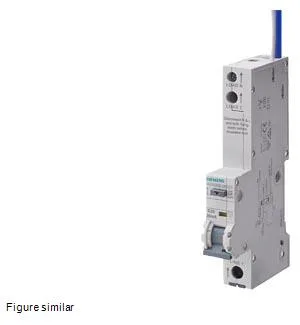
It integrates a 6 A overcurrent trip with B characteristic and a 30 mA Type A residual-current device, so one unit handles both short-circuit and earth-fault protection on a final subcircuit. Rated insulation voltage is 264 V, with a 4 kV surge-voltage withstand (overvoltage category III). This is an active-production part.
Depth is 77 mm, installation depth 70 mm — that's the dimension to check against enclosure clearance, especially if gland plates or wiring ducts sit close to the rail. Height is 125 mm. The supply can enter from either top or bottom, which simplifies panel wiring when busbar orientation forces a reverse feed. Ingress protection is IP20, but only when the distribution board is installed with conductors connected — meaning the RCBO itself isn't sealed; the enclosure provides the environmental barrier. This is standard for DIN-rail protective devices; keep it inside a cabinet, not exposed to washdown or outdoor weather.
Trip characteristics and selectivity
The B tripping characteristic (per EN 60898) means the magnetic trip operates at 3 to 5 times rated current — so 18 to 30 A for this 6 A unit. The 30 mA residual-current sensitivity (Type A) detects sinusoidal AC fault currents plus pulsating DC fault currents — the type produced by rectifier circuits in electronics, LED drivers, and single-phase VFDs. Type A is broader than Type AC and is now the minimum required by many national wiring regulations for circuits with electronic loads.
Humidity tolerance up to 95% is stated. Degree of pollution 2 (normally only non-conductive pollution occurs) is typical for protected indoor environments. Designated as an instantaneous RCD-operated circuit breaker — no intentional time delay on the residual-current function, so it trips quickly on earth faults. The test circuit requires a minimum of 115 V AC to operate the test button, which is standard for 230 V systems.