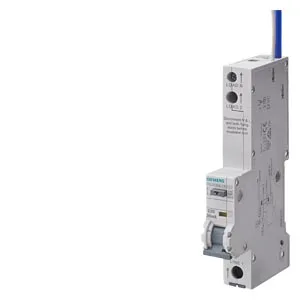
Siemens 5SU9304-7KK20 — Residual Current Breakers (RCCB/RCBO)

5SU9304-7KK20 SENTRON RCBO, 1P+N, C-curve 20 A, 10 kA

MPN5SU9304-7KK20
Active

Siemens SENTRON 5SU9304-7KK20, RCBO, 1P+N, C-curve, 20 A rated at 30 °C, 10 kA breaking capacity per EN 60898, 1 MWU, IP20.

StockContact for availability
MOQ1 pcs
Sourced new & surplus through independent channelsListing updated Jul 2026

Specifications

Electrical Ratings

5SU9304-7KK20 — Electrical Ratings
ParameterValue
Number of poles2
Overvoltage categoryIII

Identification

5SU9304-7KK20 — Identification
ParameterValue
Product designationRCD-operated circuit breaker
Product design / constructionInstantaneous

Mechanical

5SU9304-7KK20 — Mechanical
ParameterValue
Mounting positionany
Width in modular units1
Maximum75 °C
Minimum-40 °C
Width18 mm
Height125 mm
Depth77 mm
Installation depth70 mm

Environmental

5SU9304-7KK20 — Environmental
ParameterValue
IP degree of protectionIP20, if the distribution board is installed, with connected conductors

Electrical

5SU9304-7KK20 — Electrical
ParameterValue
Tripping Characteristic ClassC

Product details

What it is and what it does

The Siemens SENTRON 5SU9304-7KK20 is an RCBO — a combined residual-current device and miniature circuit breaker in a single 1-module-wide (18 mm) package. It protects a single-phase final subcircuit against overload, short-circuit, and earth leakage, with a C-curve trip characteristic that handles motor-start inrush and moderate switching loads without nuisance tripping. Rated 20 A at 30 °C ambient, it derates to 18.8 A at 40 °C and 16.2 A at 55 °C — the thermal curve matters when the device lives in a crowded enclosure. The 10 kA breaking capacity (per EN 60898 and IEC 60947-2) means it can safely interrupt a fault current up to that level, which covers the vast majority of domestic and light commercial distribution boards. It is a 1P+N design — the switched pole is protected; the neutral pole is switched but not fused. Supply can enter from top or bottom, and the device mounts in any position on the DIN rail. IP20 with the distribution board installed and conductors connected.

What the ratings mean for fit

The C-curve (tripping between 5× and 10× In) is the standard choice for mixed resistive-inductive loads — lighting circuits, small motors, pumps, and general socket outlets. If the load is purely resistive (heater, incandescent), a B-curve would be faster; if it is a heavy motor or transformer with high inrush, a D-curve might be needed. The 20 A rating at 30 °C is the headline number, but the derated values at 40 °C and 55 °C are what matter for a panel that runs warm. The 1-module-wide footprint (18 mm) saves rail space in a distribution board compared to a 2-module RCBO. The halogen-free and silicon-free construction is relevant for clean-room or high-reliability environments where outgassing must be minimised.

Frequently asked questions

Does 5SU9304-7KK20 replace 5SY4116-7CV?

No — they are different device classes. 5SU9304-7KK20 is an RCBO (overcurrent + earth leakage), while 5SY4116-7CV is a standard MCB without residual-current protection. They are not drop-in substitutes; the circuit design must account for the RCD function.

MPN
5SU9304-7KK20