What it is and what it does
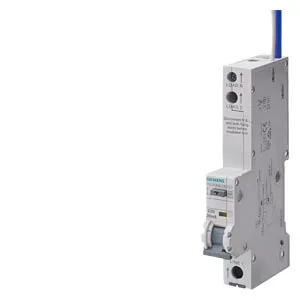
The Siemens SENTRON 5SU9304-7KK40 is a 2-pole RCD-operated circuit breaker — an RCBO — combining overcurrent protection and residual current detection in a single 18 mm (1 MW) wide module. It is rated 40 A at AC with a C-curve tripping characteristic and a 30 mA Type A residual current trip. The breaking capacity is 10 kA per EN 60898 and IEC 60947-2, overvoltage category III, pollution degree 2. This is the version that protects one pole (line) while switching both poles; the neutral pole is switched but not protected.
What the ratings mean for fit
The 40 A rating at 30 °C derates to 37.6 A at 40 °C and 32.4 A at 55 °C (–). If your panel ambient sits at 45 °C, you're limited to 36.4 A continuous — a 3.6 A drop from the nameplate. The 30 mA Type A residual current trip catches pulsating DC fault currents from electronics and rectified loads, not just pure sinusoidal AC. The C-curve (magnetic trip between 5× and 10× In) suits inductive loads like motor starters and small transformers where inrush won't nuisance-trip a B-curve. The 10 kA breaking capacity at 230/400 V is adequate for most residential and light commercial distribution boards; if your available fault current exceeds that at the point of installation, you need an upstream current-limiting device.
Mounting and integration
Snaps onto standard 35 mm DIN rail. The 18 mm width (1 MW) means it occupies one modular unit — critical when you're packing multiple RCBOs into a sub-distribution board. Installation depth is 70 mm, overall depth 77 mm including the housing. Mounting position is unrestricted: horizontal, vertical, upside-down — the electromechanical mechanism and arc chamber are orientation-independent. Supply can enter from top or bottom; the terminals accept up to 25 mm² conductor. IP20 with conductors connected, which is standard for enclosed distribution boards.
