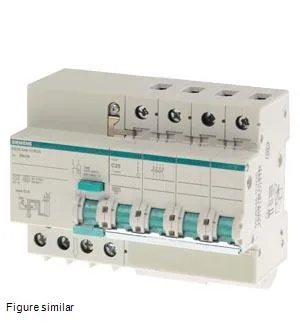
The Siemens 5SU9346-7CR50 is a 4-pole RCD-operated circuit breaker (RCBO) from the SENTRON family — it combines overcurrent protection and residual current detection in one 2-module-width unit. The C-curve (tripping characteristic class C) means it holds through inrush up to 5–10× rated current before opening, so it's sized for motor and light transformer loads where the start-up surge would nuisance-trip a B-curve breaker. Rated 50 A at 30 °C on a 400 V AC supply, it handles the typical three-phase distribution board feed. The residual current element is Type A, 30 mA — that covers sinusoidal AC fault currents plus pulsating DC faults from rectified loads (switch-mode supplies, VFDs, LED drivers). With 4 poles protected, this unit guards all live conductors in a three-phase plus neutral circuit.
The EN 60898 figure governs domestic and light commercial boards; the IEC 60947-2 figure applies when the RCBO is specified into an industrial distribution panel where the prospective fault current is higher. Energy limitation class 3 means the let-through energy (I²t) is low enough that downstream wiring and connected equipment see less thermal stress during a fault. For a panel-builder coordinating a distribution board, that's the difference between a clean trip and a cascading failure that takes out upstream breakers.
Snap-on mounting to DIN rail, any position. The 2-module-width body takes up 36 mm on the rail — that's two standard 18 mm slots. Supply can enter from top or bottom, which simplifies busbar routing in a crowded enclosure.
Surge current resistance at 8/20 μS is 1 kA — that's the impulse withstand for lightning-induced surges on the supply side. Surge voltage resistance rated at 4 000 V covers the dielectric withstand between live and accessible metal parts.