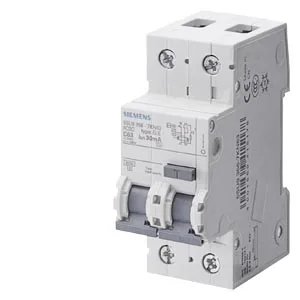
The Siemens 5SU9354-8KK16 is a SENTRON RCBO — an RCD-operated circuit breaker combining overcurrent and residual-current protection in a single 2-module-wide (36 mm) package. It's a 1P+N design, meaning it switches and protects the line conductor only; the neutral is switched but not protected. That's standard for single-phase final circuits in TN or TT systems where you don't need a protected neutral. The D tripping characteristic means the magnetic release trips at 10 to 20 times the rated current. That's deliberately high — D-curve is for loads with a large inrush, like small motors, transformers, or discharge lighting. D is the right call for inductive or high-starting-current loads. Rated 16 A at 30 °C ambient, but the thermal derating curve is published: 15.04 A at 40 °C, 14.56 A at 45 °C, 13.92 A at 50 °C, and 12.96 A at 55 °C (–). If your panel ambient runs at 45 °C, you're effectively working with a 14.56 A device — plan your load accordingly.
Snap-on mounting to DIN rail (implied by the SENTRON modular form factor). At 2 MWU (36 mm wide,) it occupies two standard 18 mm slots. Installation depth is 70 mm; total depth including the front projection is 77 mm. That's a shallow profile — fits most distribution boards without crowding the gland plate.