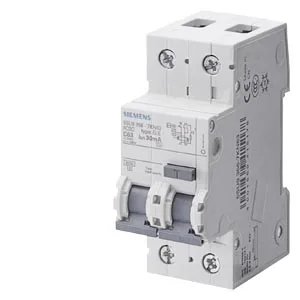
The Siemens 5SU9354-8KK40 is a SENTRON RCD-operated circuit breaker — an RCBO that combines overcurrent protection and residual-current detection in one 2-MW (36 mm wide) module. The Type A fault-current detection catches pulsating DC as well as sinusoidal AC earth faults, which matters on single-phase drives or switched-mode supplies that generate DC ripple on the line.
Energy limiting class 3 means it lets through less let-through energy than a lower-class breaker, which helps protect the wiring and the load side.
Thermal derating — read the real current
In a warm panel — say 45 °C — the continuous current drops to 36.4 A; at 55 °C it's 32.4 A. If the load is a 3.7 kW motor drawing about 7 A per phase, you have headroom. But if you're pushing a 36 A continuous resistive load in a hot cabinet, the D-curve won't nuisance-trip on inrush, but the thermal element will eventually open at the derated value.
Integration notes
Two width units (36 mm) on standard DIN rail. The neutral pole is switched (not just solid), so it isolates both conductors on a fault. Touch protection is built in; pollution degree 2 covers normal industrial environments with non-conductive dust.