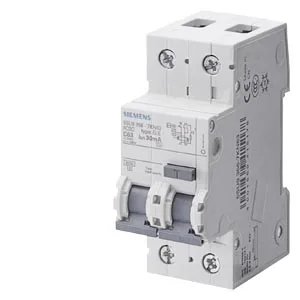
The Siemens 5SU9356-1KK10 is a SENTRON RCBO — a combined RCD and MCB in one 2-module-width (36 mm) package. Rated 10 A at 30 °C, it derates to 9.4 A at 40 °C and 8.1 A at 55 °C — the thermal curve matters if the RCBO lives in a crowded enclosure or near heat sources.
No official successor has been announced for this order code. The SENTRON RCBO family is broadly stable; if a panel was specified around the 5SL6550-7BB, the 5SU9356-1KK10 shares the same 2-MW footprint and 1P+N topology but differs in breaking capacity and trip characteristic — verify the downstream load before substituting.
Integration and compliance notes
IP20 rating applies once the board is closed and conductors are connected — the RCBO itself is not touch-safe live. Halogen-free and silicon-free construction, so it meets clean-room and low-smoke requirements for data-center or medical-grade panels. Surge voltage resistance rated at 4 kV, surge current resistance 1 kA (8/20 μs waveform). Insulation voltage 264 V, operating voltage 230/240 V AC at 50/60 Hz. The test button requires a minimum of 195 V to function correctly.