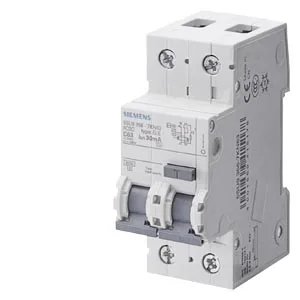
What this RCBO is and what it protects
The Siemens 5SU9356-1KK20 is a SENTRON-series residual-current-operated circuit breaker (RCBO) combining overcurrent and earth-fault protection in a single 2-module-wide (36 mm) package. It protects a single-phase final subcircuit at 230/240 V AC, 50/60 Hz, with a rated current of 20 A and a C tripping characteristic — meaning it tolerates the inrush of motor or lighting ballast loads before the thermal-magnetic trip operates. The residual-current element is Type AC, 30 mA, covering sinusoidal AC fault currents to earth. Breaking capacity is 6 kA per EN 60898 (the household-standard rating) and 10 kA per IEC 60947-2 (the industrial-standard rating). That 10 kA figure is the one to use when the device sits downstream of a transformer with a high prospective fault current — it tells you the RCBO can interrupt a 10 kA fault without welding its contacts or rupturing the case, per the industrial standard's test sequence.
Mounting and integration into the panel
Snaps onto a 35 mm DIN rail per EN 60715. At 2 MW (36 mm wide), it occupies two adjacent positions in the distribution board. The supply cord can enter from either top or bottom — no mandatory orientation — and the mounting position is any, so it fits vertical or horizontal rail layouts. Installation depth is 70 mm; overall depth including the front arc is 77 mm. The IP20 rating applies only when the distribution board is closed and conductors are connected — treat the device as touch-hazardous while the panel is open. The RCBO is halogen-free and silicon-free, which matters in environments where outgassing from a fault could contaminate nearby electronics or where silicone vapours interfere with paint adhesion or contact reliability. Pollution degree 2 and overvoltage category III are standard for fixed-installation final circuits in residential and light commercial panels.
Thermal and environmental limits
Ambient operating range spans -40 °C to +75 °C, with a maximum 95% humidity influence. The 0.75 W power dissipation per pole at rated current in hot operating state is the figure to use for thermal derating inside a crowded enclosure — sum across poles and check against the enclosure's dissipation limit. Mechanical service life is 10 000 operating cycles typical.