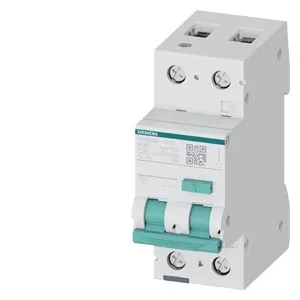
The 'type AC' detection handles sinusoidal AC residual currents only; if your circuit has pulsed DC or smooth DC fault currents (variable-speed drives, UPS systems), you'd want a type A or F instead.
The D-curve trip threshold (10–20× In) delays tripping long enough for motor-starting or capacitor-bank inrush to pass without nuisance trips. The 1+N configuration switches the line conductor and disconnects the neutral but does not protect the neutral against overcurrent; it's the standard arrangement for single-phase final circuits in many European and Asian markets.
Panel Integration
The Construction line designation indicates it's built for the residential and commercial building market — compact module width, finger-safe terminals, and a busbar-compatible connection system for multi-pole grouping. Verify the busbar pitch matches your panel's layout before committing the assembly.