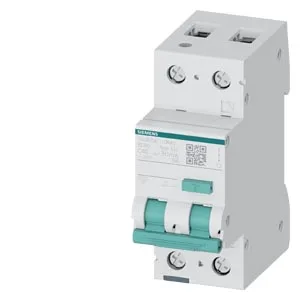
The Siemens 5SU9356-7KP32 is a SENTRON RCD-operated circuit breaker — a combined overcurrent and residual-current device (RCBO) in a single 36 mm-wide, 2-module package. It's rated 32 A at 30 °C with a C tripping characteristic, meaning it handles moderate inrush from motor starters or capacitor banks without nuisance trips, while the 6 kA breaking capacity per EN 60898 (10 kA per IEC 60947-2) clears line-to-neutral faults up to that level. The Type A fault-current detection catches both sinusoidal AC and pulsating DC residual currents, which covers most modern electronic loads like VFDs and switched-mode power supplies.
The unit occupies 2 width units (36 mm) on a DIN rail, with an installation depth of 70 mm and overall depth of 77 mm — fits standard 80 mm-deep enclosures. Terminals accept solid or stranded conductors from 0.75 mm² up to 35 mm², covering everything from 1.5 mm² lighting circuits up to 10 mm² feeder tails. The max power loss of 1.5 W per unit means derating within a multi-pole assembly is minimal — you can pack several of these side by side without cooking the enclosure. Ambient temperature range is -25 to +45 °C, with derating above 30 °C: 30.08 A at 40 °C, 29.12 A at 45 °C, 27.84 A at 50 °C, 25.92 A at 55 °C.
The 5SU9 design series is the active SENTRON RCBO line, so you can spec it into new BOMs without worrying about a forced redesign next year. Touch protection is built into the terminals — no exposed live parts when wired correctly.
Compared to the standard MCB-only 5SL6563-7BB (a 32 A C-curve without RCD), the 5SU9356-7KP32 adds Type A residual-current protection in the same 2-module footprint. If your panel was laid out around the 5SL6563-7BB, this RCBO drops into the same DIN-rail slot and terminal range — no rewiring needed for the line and load connections, but you gain the ground-fault trip function.