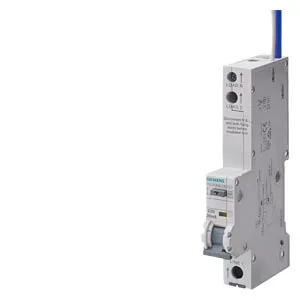
The Siemens SENTRON 5SU9404-0KK32 is an RCD-operated circuit breaker — an RCBO — combining overcurrent protection and residual current detection in a single 18 mm wide module. The 1P+N configuration switches the live pole and provides a switched neutral, which is common in single-phase final circuits across European and Middle Eastern markets.
Thermal derating and conductor sizing
At 40 °C it derates to 30.08 A, at 45 °C to 29.12 A, at 50 °C to 27.84 A, and at 55 °C to 25.92 A. The terminals accept solid or stranded conductors from 0.75 mm² up to 35 mm², which covers everything from 1.5 mm² lighting circuits up to 10 mm² feeder tails. The installation depth is 70 mm, and the overall depth is 77 mm, so it fits standard 18 mm DIN-rail enclosures with a 70 mm deep back box. Mounting position is unrestricted, and the supply can enter from either top or bottom.
Rated breaking capacity is certified to EN 60898 (10 kA) and IEC 60947-2 (10 kA). Touch protection is provided on the terminals. The product is assigned function code F per DIN EN 61346-2 and DIN EN 81346-2, which classifies it as a protective device.