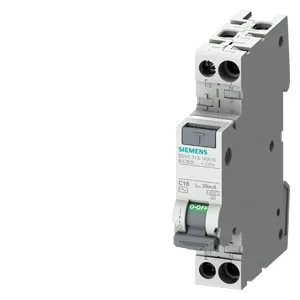
What bolts in — and what that 30 mA means on the line
Siemens SENTRON 5SV1313-1KK06 is a 1P+N RCBO — one module wide (18 mm), rated 6 A at 30 °C with a C-curve trip characteristic and 30 mA residual-current detection. Good for most distribution boards fed from a 10 kA or lower upstream breaker. Mounts in any position, top or bottom feed, one modular width (18 mm). Panel builders: that's one 18 mm slot on the DIN rail. No ventilation gaps needed; it's rated for 75 °C max ambient, but the thermal derating curve below 30 °C is where you plan your load — at 40 °C it's down to 5.64 A, at 50 °C to 5.28 A. If you're loading it near 6 A in a warm cabinet, you'll trip on overload before the RCD sees a fault.
How it sits against a common panel sibling
The 5SY series (e.g. 5SY4106-7CV) is a pure MCB — no residual-current element. The 5SV1313-1KK06 is an RCBO: one device does both overcurrent and earth-fault protection. If your panel was wired around a 5SY MCB plus a separate RCCB, the 5SV1313-1KK06 replaces both in a single 18 mm width. Same DIN footprint, same C-curve, same 6 A rating at 30 °C — but you lose the separate RCD module. Panel builders: check whether your existing busbar or distribution block accommodates the RCBO's wider internal profile; mechanically it clips the same DIN rail.
IP20, pollution degree 2 — clean indoor gear only
IP20 with conductors connected — that's finger-safe when installed in an enclosed distribution board. Not for washdown, not for outdoor exposure. Overvoltage category III means it's rated for fixed-installation downstream of the service entrance — not for plug-in portable gear.
Residual current type AC — what it catches and what it doesn't
Type AC residual current detection means it trips on sinusoidal AC earth faults only. It will NOT detect pulsating DC (Type A) or smooth DC (Type B) residual currents. If your load includes VFDs, switching power supplies, LED drivers, or any half-wave rectified gear, you need a Type A or Type B RCD. Type AC is fine for resistive heating, incandescent lighting, and motor circuits without electronic drives. Know your load harmonics before you spec this.