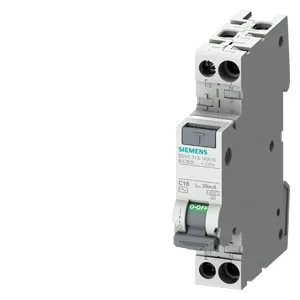
It occupies a single modular-width unit (18 mm) on the DIN rail and protects a single-phase 230 V AC circuit at 50 Hz. Rated 6 A at 30 °C ambient, the part is temperature-derated through a published curve: 5.64 A at 40 °C, 5.46 A at 45 °C, 5.28 A at 50 °C, 5.04 A at 55 °C, 4.86 A at 60 °C, 4.62 A at 65 °C, and 4.44 A at 70 °C. In a warm panel, the effective rating drops — size the upstream protection accordingly.
Breaking capacity is rated at 4.5 kA according to EN 60898 and 5 kA according to IEC 60947-2. The higher figure under the industrial standard gives you a bit more fault-current headroom in a commercial or light-industrial panel where the prospective short-circuit current may exceed 4.5 kA. Energy limitation class 3 indicates the let-through energy under fault is limited, reducing stress on downstream wiring and connected equipment.
Halogen-free and silicon-free construction supports use in environments with strict outgassing requirements — control cabinets near sensitive electronics, or ventilation-restricted enclosures.
The 18 mm width (1 MWU) leaves room for adjacent breakers in a multi-pole assembly. Supply can enter from either the top or bottom terminals. The IP20 rating applies only when the distribution board is installed with connected conductors — the front face is touch-safe, but the terminals are not protected against water ingress. Minimum test voltage of 195 V AC is specified for functional testing of the residual-current element — ensure your test equipment can supply that level.